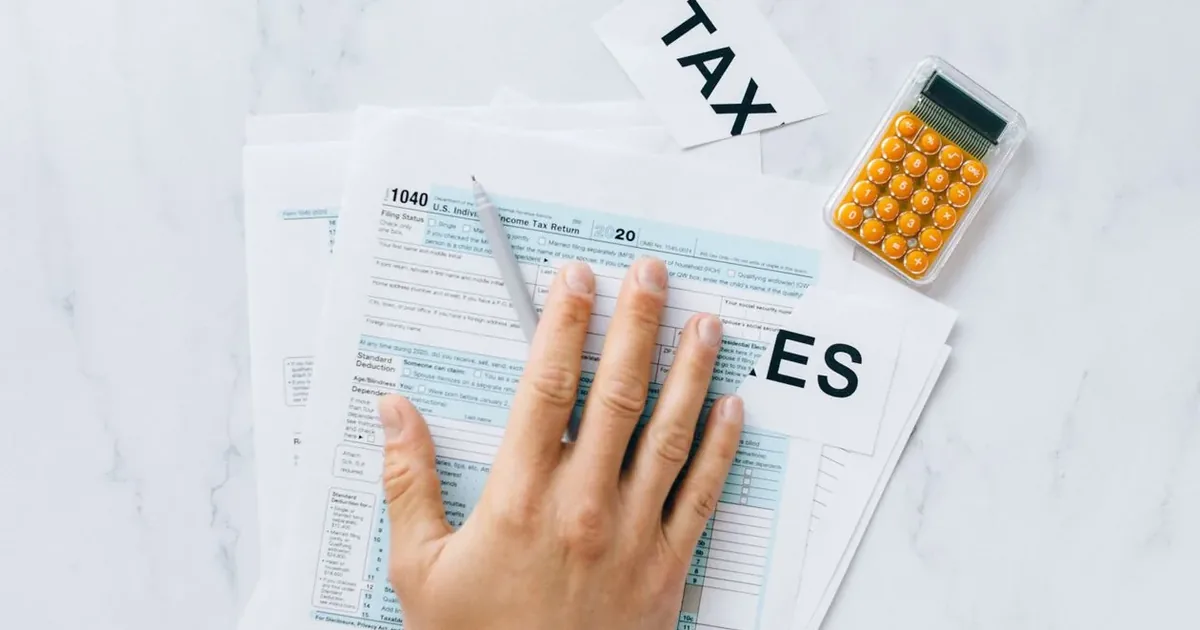
When you earn a paycheck, your employer handles taxes behind the scenes. Federal income tax and Social Security and Medicare taxes come out of every check before the money reaches you. Self-employment works differently. Nobody withholds anything. You pay the IRS directly, in four installments across the year, using Form 1040-ES.
That payment schedule is what people call quarterly estimated tax. This guide walks through everything a self-employed worker needs to know for 2026: whether you have to pay, the four deadlines, how to calculate each payment, how much of your income to set aside, and how the safe harbor rule protects you from penalties.
Who has to pay quarterly estimated tax in 2026?
The IRS runs a pay-as-you-go system. It expects to receive your tax money during the year as you earn income, not in one lump sum the following April. Two separate rules decide whether quarterly payments apply to you.
First, the $1,000 rule. You generally have to make estimated tax payments if you expect to owe at least $1,000 in federal tax for 2026 after subtracting any withholding and refundable credits. Most full-time freelancers and independent contractors clear this line easily. If you expect to owe less than $1,000, you can skip quarterly payments and settle up when you file.
Source: IRS Form 1040-ES (2026) and IRS Publication 505 (2026), Tax Withholding and Estimated Tax.
Second, the $400 rule. This one covers self-employment tax specifically. If your net earnings from self-employment reach $400 or more for 2026, you owe self-employment tax,and you file Schedule SE with your return. Net earnings means your business revenue minus your allowable business expenses. Gross receipts do not count; profit does.
Do you need to pay quarterly taxes in your first year on 1099 income?
Yes, if the two rules above apply to you. First-year 1099 workers get caught by this more than anyone else. When you worked a W-2 job, withholding covered your obligation automatically, so the question never came up. Your first year of freelancing or contracting is the first time the pay-as-you-go requirement falls on you directly.
There is one extra wrinkle for new freelancers. The easiest way to avoid the underpayment penalty, the prior-year safe harbor, uses last year’s tax return as a benchmark. That method still works if you were a W-2 employee last year, because the IRS only looks at the total tax shown on your return, not how you earned it. If you had no tax liability at all last year (your total tax was zero or you were not required to file), you do not have to make estimated payments this year, provided your 2025 tax year covered a full 12 months and you were a U.S. citizen or resident alien for all of 2025. The safe harbor section below covers both methods in detail.
The four quarterly estimated tax deadlines for 2026
The IRS sets four due dates for calendar-year taxpayers. They do not line up with normal calendar quarters, which trips up a lot of new freelancers. Here are the 2026 dates:
| Payment | Period covered | Due date |
|---|---|---|
| Q1 | January 1 to March 31, 2026 | April 15, 2026 |
| Q2 | April 1 to May 31, 2026 | June 15, 2026 |
| Q3 | June 1 to August 31, 2026 | September 15, 2026 |
| Q4 | September 1 to December 31, 2026 | January 15, 2027 |
For next year, see the 2027 tax figures, including the 2027 quarterly deadlines.
A few details worth knowing. If a due date falls on a weekend or a federal holiday, the IRS moves the deadline to the next business day. None of the four 2026 dates need that shift. April 15 is a Wednesday, June 15 is a Monday, September 15 is a Tuesday, and January 15, 2027 is a Friday.
Notice that the second payment covers only two months of income, not three. The IRS designed the schedule so that each payment roughly matches the income period before it, even though the spacing looks uneven. If you file your 2026 return by February 1, 2027 and pay the full balance at that point, you can skip the January 15 payment entirely.
For a deeper look at each deadline and what to do if a payment is late, see 2026 Quarterly Tax Deadlines: The 4 Dates Self-Employed Workers Can’t Miss.
What counts as estimated tax for self-employed workers?
Your estimated payments cover two different taxes in one amount.
The first is federal income tax on your profit. After subtracting business expenses, half of your self-employment tax, and either the standard deduction or your itemized deductions, the 2026 tax brackets apply to what remains.
The second is self-employment tax, which funds Social Security and Medicare. The rate is 15.3% of your net earnings, made up of 12.4% for Social Security and 2.9% for Medicare. The IRS does not apply this to your full profit. You first multiply your net earnings by 92.35%, and the 15.3% applies to that adjusted number. This adjustment exists because employees effectively have the employer half of payroll tax paid on their behalf; the 92.35% factor puts self-employed workers on roughly equal footing.
Two limits shape the calculation for 2026:
- The 12.4% Social Security portion applies only to the first $184,500 of your adjusted net earnings. That figure is the Social Security wage base set by the Social Security Administration each year. Earnings above it owe no Social Security tax, though the Medicare portion has no cap.
- If your combined wages and self-employment income pass $200,000 for single filers or $250,000 for married couples filing jointly ($125,000 if married filing separately), an additional 0.9% Medicare tax applies to the amount above the threshold. These thresholds are set by statute and do not adjust for inflation.
One more tax break matters for the math. You can deduct half of your self-employment tax as an adjustment to income on your return. That deduction lowers your adjusted gross income, which reduces the income tax portion of your bill. The 0.9% Additional Medicare Tax does not come with a matching deduction.
How to calculate quarterly estimated taxes when self-employed
Form 1040-ES includes an Estimated Tax Worksheet that walks through the full calculation. The logic behind it runs in five steps.
- Estimate your total income for 2026. Add up expected freelance and contract income, plus any other income such as interest, dividends, or a W-2 job on the side.
- Subtract your adjustments and deductions. Start with your business expenses, then subtract half of your expected self-employment tax. Then subtract either the standard deduction ($16,100 for single filers, $32,200 for married couples filing jointly, $24,150 for heads of household in 2026) or your expected itemized deductions, whichever is larger.
- Figure your income tax and self-employment tax on what remains. Apply the 2026 income tax brackets to your taxable income, and calculate self-employment tax at 15.3% on 92.35% of net earnings.
- Add the two taxes together, then subtract any withholding from a W-2 job and any refundable credits. The result is your expected total tax for the year.
- Divide by four. That is your quarterly payment.
A worked example shows how the moving parts fit together. Take a single filer with $80,000 in net profit for 2026 and no W-2 withholding.
Self-employment tax first. Adjusted earnings come to $80,000 times 92.35%, or $73,880. The 15.3% rate applies to that figure: $73,880 times 15.3% equals $11,304 in self-employment tax. That breaks into $9,161 of Social Security tax and $2,143 of Medicare tax, and the whole amount is well under the $184,500 Social Security wage base.
Half of that self-employment tax, $5,652, is deductible above the line. Subtract it from the $80,000 profit to get adjusted gross income of $74,348. Subtract the 2026 single standard deduction of $16,100, leaving taxable income of $58,248. Apply the 2026 brackets to that number, add the $11,304 of self-employment tax, and divide the total by four for each quarterly payment.
Running the whole calculation takes a few minutes the first time. If you want a faster answer, the free 1099 tax estimator handles the arithmetic for you. It applies the 2026 figures above and returns both your total bill and the per-quarter amount.
A note for people with uneven income
Dividing by four assumes you earn roughly the same each quarter. Freelancers often do not. If most of your income lands in the back half of the year, equal installments mean overpaying early, and if it all arrives in January, you risk a shortfall penalty later.
The IRS offers a formal fix for this: the annualized income installment method, claimed on Schedule AI of Form 2210. It lets you base each payment on the income you had actually earned when that payment was due. Filing it adds paperwork, so most people with steady income skip it, but it is the right tool if your earnings swing hard between quarters.
How much should you set aside for 1099 taxes?
The calculation above gives an exact number, but most freelancers want a simple rule for moving money aside from every payment they receive. A good starting point is 25 to 30% of each freelance check, transferred into a separate savings account before you touch it.
That percentage is a buffer, not a prediction. Whether 25% covers your actual bill depends on your profit level, your filing status, and your deductions. Higher earners can need more, because marginal tax rates climb while the Social Security portion of self-employment tax falls away above $184,500. People with large business expense deductions can need less. Treat the percentage as a habit, then check it against a real calculation once or twice a year and adjust.
Two practical habits make this painless. First, move the money the day you get paid. Tax money sitting in your checking account has a way of feeling available. Second, keep a simple spreadsheet or use accounting software that tracks profit and the set-aside side by side, so you see the gap before a deadline arrives.
Estimate your quarterly payments with the free 1099 Tax Calculator
The safe harbor rule: how to avoid the underpayment penalty
Missing quarterly payments can trigger an underpayment penalty, which the IRS calculates as interest on each quarter’s shortfall from the date that payment was due. You can owe a penalty even if you pay your full tax bill when you file in April, because the penalty covers the quarters you were short, not the final balance.
The safe harbor rule is your protection. The IRS waives the penalty if your total withholding and estimated payments reach at least one of these targets by year end:
- 90% of your actual 2026 tax, or
- 100% of the total tax shown on your 2025 return, if your 2025 adjusted gross income was $150,000 or less ($75,000 if married filing separately), or
- 110% of the total tax shown on your 2025 return, if your 2025 adjusted gross income was above $150,000.
Most self-employed workers with unpredictable income pick the prior-year method, because it turns an unknown number into a known one. A concrete example helps. Suppose your 2025 return showed total tax of $12,000 and your 2025 adjusted gross income was under $150,000. Paying $12,000 through a mix of withholding and four quarterly payments of $3,000 each keeps you penalty-free for 2026, no matter what your actual 2026 income turns out to be. If your 2026 income is higher and your real bill comes to $18,000, you owe the $6,000 difference when you file, but no penalty applies to it. Had your 2025 adjusted gross income exceeded $150,000, the target would be 110% instead: $13,200 total, or $3,300 per quarter.
One warning. Safe harbor protects you from the penalty, but it does not reduce your tax. A much better year than last year still produces a large balance due in April. Budget for that.
For the full breakdown, including who qualifies for which percentage, read The Safe Harbor Rule: How Self-Employed Workers Avoid the Underpayment Penalty.
How to pay your quarterly estimated tax
You do not file Form 1040-ES with a return; you use it to pay. The IRS offers several payment channels:
- IRS Direct Pay, which pulls the payment from your bank account for free
- IRS Direct Pay or your IRS Online Account, which both let you schedule estimated payments in advance (EFTPS no longer accepts new enrollments from individuals)
- Debit or credit card through an IRS-authorized processor, which adds a processing fee
- A check or money order mailed with the paper Form 1040-ES payment voucher
Apply each payment to the right quarter when you pay. If you pay online, you select the tax year and quarter. Getting this right matters because the IRS measures penalties quarter by quarter. A double payment in April does not retroactively cover a missed January deadline.
The full walkthrough, including screenshots of the worksheet and each payment channel, is in Form 1040-ES Explained: How to Fill It Out and Pay Estimated Tax in 2026.
What happens if you miss a quarterly payment?
You are not fined a flat amount. The IRS charges interest on the shortfall for the period between the missed deadline and the date you pay, at the federal short-term rate plus 3 percentage points. The interest compounds daily, so a payment that is three months late costs roughly three times what a one-month-late payment costs.
The fix is simple: pay as soon as you realize you missed it. Every day you wait adds interest, so there is no benefit to waiting for the next deadline. If cash is tight, pay what you can now and catch up with the next installment. And if you discover you missed all four quarters, paying the entire balance with your return still leaves the interest for each quarter, but the bleeding stops the day you pay.
There are a few situations where the IRS waives the penalty outright, including casualty or disaster, and you can request a waiver on Form 2210 if you had reasonable cause. Full details are in Missed a Quarterly Tax Payment? Here’s What Happens and How to Fix It.
Going from W-2 to 1099: a first-year checklist
The first year of self-employment is when most quarterly tax mistakes happen. This checklist covers the essentials.
- Register for an IRS Online Account early, so you can pay electronically before the first deadline arrives (EFTPS no longer accepts new enrollments from individuals).
- Run the Form 1040-ES worksheet with your best estimate of the year’s profit. You can adjust the numbers each quarter as the real picture sharpens.
- Open a separate savings account and move 25 to 30% of every client payment into it the day you are paid.
- If you still have a W-2 job, consider raising your withholding instead of making estimated payments. Withholding is treated as paid evenly across the year, so a late-year increase can cover early-year shortfalls in a way that a late estimated payment cannot.
- Track expenses from day one. Every deductible business expense lowers both your income tax and your self-employment tax.
Recordkeeping that keeps you out of trouble
The IRS advises keeping tax records for 3 years from the date you filed your return or 2 years from the date you paid the tax, whichever is later. For quarterly estimated tax, keep proof of each payment: confirmation numbers from online payments and copies of the Form 1040-ES vouchers you mailed. If the IRS ever questions whether you paid on time, that paper trail is your answer.
Also keep the records behind your estimates. If you used the prior-year safe harbor, keep the prior year’s return. If you used the annualized income method, keep the quarterly income records that supported it. Schedule C profit and loss records, receipts, and mileage logs round out the set.
Frequently asked questions
Is quarterly tax the same as self-employment tax?
No. Self-employment tax is one component of what your quarterly payments cover. Your estimated payments combine self-employment tax (15.3% on 92.35% of net earnings, up to the Social Security wage base) with federal income tax on the same profit. One payment covers both.
Can I just pay once a year in April?
You can pay the balance in April, but you cannot pay quarterly obligations once a year without consequences. The underpayment penalty applies separately to each quarter you underpaid, even if your return shows the correct total. The only way a single April payment works is if you had no required quarterly payments at all, or if you meet one of the safe harbor targets through W-2 withholding.
What if my income changes mid-year?
Recalculate and adjust the remaining payments. The Form 1040-ES worksheet is designed to be re-run whenever your estimate changes. Raising a later payment does not erase a shortfall from an earlier quarter, but it keeps the remaining quarters compliant. If your income falls, you can lower the remaining payments the same way.
Do estimated payments apply to state taxes too?
Most states with an income tax have their own estimated payment requirements, often with matching deadlines. This guide covers federal tax only. Check your state’s revenue department for its own forms and dates.
The bottom line
Quarterly estimated tax is the price of being your own boss in a pay-as-you-go system. Mark the four 2026 deadlines, run the Form 1040-ES worksheet or use a calculator, set aside 25 to 30% of each payment you receive, and lean on the safe harbor rule when your income is hard to predict. Do that consistently and the system becomes routine rather than stressful.
This article is for educational purposes only and is not tax or legal advice. Tax rules, figures, and deadlines can change. Verify current information on IRS.gov or consult a qualified tax professional about your situation.
Run your 2026 numbers with the free 1099 Tax Calculator
References
- IRS Form 1040-ES (2026), Estimated Tax for Individuals
- IRS Publication 505 (2026), Tax Withholding and Estimated Tax
- IRS Form 2210 (2026), Underpayment of Estimated Tax by Individuals, Estates, and Trusts