
By Casey Renee Tom | Reviewed November 2026 for tax year 2026
Massage therapist taxes are the US federal tax rules for earning money giving massages as a licensed massage therapist (LMT) or bodyworker. The IRS treats most booth renters, mobile therapists, and spa contractors as self-employed. You report the income on Schedule C, pay income tax plus self-employment tax on your profit, and pay quarterly estimates when you owe $1,000 or more. This guide covers wellness and spa massage only, not mental health therapy. For the rules that apply to every self-employed worker, see our independent worker tax guide.
Do massage therapists have to pay taxes?
Yes. Every dollar you earn from massage work is taxable income, from the first session. Session fees, tips, and retail product sales all count. No 1099 form is needed to create the tax. You must file a return and pay self-employment tax if your net earnings from self-employment reach $400 for the year, under 26 U.S.C. section 1402(b). Net earnings means massage revenue minus deductible business expenses.
How much is self-employment tax for a massage therapist?
Self-employment tax is 15.3 percent of your net earnings from self-employment: 12.4 percent for Social Security and 2.9 percent for Medicare, under IRS Schedule SE for tax year 2026. It applies once net earnings reach $400 for the year, and it is separate from income tax.
Schedule SE first multiplies net profit by 92.35 percent to get net earnings, then applies the 15.3 percent rate. The Social Security portion applies only to the first $184,500 of combined wages and net earnings for 2026, the wage base published by the Social Security Administration. On $40,000 of net profit, net earnings are $36,940, self-employment tax is about $5,652, and you can deduct one-half of that tax, about $2,826, on Schedule 1 of Form 1040, line 15.
Booth rent or percentage split: how is each reported?
Self-employed massage therapists usually work under one of two arrangements. Under booth rent, you pay the spa a flat monthly amount for a room or table space. Under a percentage split, the spa collects the session fee and keeps a share, often 40 to 60 percent.
| Arrangement | What you report | Schedule C line |
|---|---|---|
| Booth rent (flat monthly rent) | Gross session fees as income; rent as an expense | Line 20b, rent of other business property |
| Percentage split | Gross session fees as income; the spa’s share as an expense | Line 10, commissions and fees |
Report the gross amount either way, then deduct what you paid the spa. Reporting only the payout that reached your bank account understates both income and expenses. If the spa pays you only your share and issues a 1099-NEC for that amount, report that amount; do not deduct the spa’s share again.
A spa that pays you $2,000 or more in 2026 must send you a Form 1099-NEC, under the Instructions for Forms 1099-MISC and 1099-NEC for tax year 2026. The threshold rose from $600 to $2,000 for payments made after December 31, 2025. If clients pay through a payment app or booking platform, the 1099-K rule is different: more than $20,000 and more than 200 transactions, and both conditions must hold.
What can massage therapists deduct?
You can deduct any ordinary and necessary cost of running your massage practice, under Internal Revenue Code section 162. Each deduction lowers the profit the IRS taxes.
| Deduction | Schedule C line | Notes for 2026 |
|---|---|---|
| Booth or room rent | Line 20b | Spa room or suite rent |
| Spa percentage split | Line 10 | The spa’s share of session fees |
| Mileage | Line 9 | 72.5 cents per mile Jan-Jun; 76 cents Jul-Dec |
| Liability insurance | Line 15 | Professional liability premiums |
| Supplies | Line 22 | Oils, lotions, linens, hot stones, sanitizer |
| Continuing education (CEUs) | Line 27b | Skill-maintaining courses |
| Membership dues | Line 27b | AMTA or ABMP membership |
| Booking software | Line 27b | Scheduling and payment apps |
| Home office | Line 30 | $5 per sq ft, max $1,500 |
Continuing education deserves care. Courses that maintain or improve the skills your current practice requires, including CEUs your state requires to renew your license, are deductible under Treasury Regulation section 1.162-5. Your original massage school tuition is not deductible, because it met the minimum requirements to enter the profession. Many therapists buy liability coverage through an AMTA or ABMP membership, which bundles the policy with the dues. Deduct the premium on line 15 and the dues on line 27b, itemized in Part V of Schedule C.
Mileage matters most for mobile therapists. The drive from one client’s home to the next counts, and so does the drive from your last client back to your home office. The drive from home to your first job of the day is a personal commute and does not count, under IRS Publication 463 (2025). With 6,000 business miles split evenly across the year, the deduction is $2,175 for the first half and $2,280 for the second, $4,455 total. Small equipment is simpler: the de minimis safe harbor lets you expense items costing $2,500 or less each instead of depreciating them, and Section 179 expensing reaches $2,560,000 for 2026. Mobile work has the same shape as house cleaner taxes.
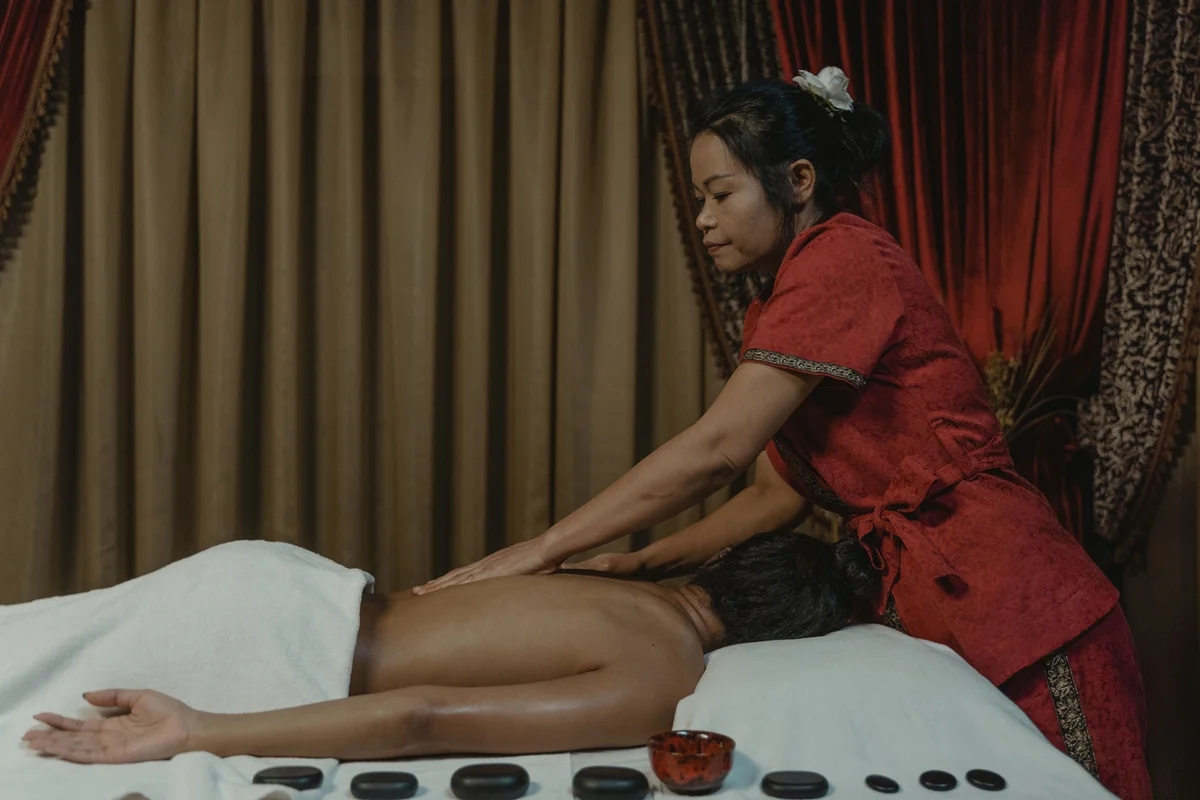
Photo by Tima Miroshnichenko on Pexels. Source: https://www.pexels.com/photo/a-masseuse-doing-a-massage-6187294/
See what your massage profit means for your tax bill with our free 1099 tax calculator, no signup needed: Estimate your 2026 massage therapist taxes with our free tax tools.
Can massage therapists deduct tips under no tax on tips?
Yes, for 2026. The One Big Beautiful Bill Act added Internal Revenue Code section 224, which lets workers in listed tipped occupations deduct up to $25,000 of qualified tips a year from federal income tax for tax years 2025 through 2028. The Treasury final regulations (TD 10044, Federal Register, April 13, 2026) list Treasury Tipped Occupation Code 602, Massage Therapists. Claim it on Schedule 1-A (Form 1040), Part II, whether you itemize or take the standard deduction.
Four conditions decide whether your tips qualify. The tip must be voluntary, not negotiated, and set by the customer. It must appear on an information return, such as a Form 1099, or be reported by you on Form 4137. Your modified adjusted gross income must stay under the phaseout, which starts at $150,000 single and $300,000 joint, and if you are married you must file jointly. Tips from a self-employed massage business also cannot exceed that business’s net profit.
The deduction cuts federal income tax only, not self-employment tax. A tip that is not reported anywhere does not qualify, so keep a daily tip log with the date, the client, and the amount. One open question does not block 2026 claims: section 224 excludes tips earned in a specified service trade or business, and whether massage therapy counts as one is unsettled, but under IRS Notice 2025-69 the IRS treats anyone in a listed tipped occupation as not in a specified service trade or business for 2025 and 2026.
Am I an employee or an independent contractor?
The answer decides which tax forms you file and whether you can deduct business expenses at all. Many spas hand therapists a 1099 while treating them like staff: the spa sets the schedule, sets the prices, assigns the clients, and provides the room, table, and supplies. A contract that calls you a contractor does not settle the question. The IRS looks at who actually controls the work, under its common-law test of behavioral control, financial control, and the type of relationship. You look self-employed when you rent your own room, set your own hours and rates, and carry your own liability insurance. Employees get a W-2, and since 2018 W-2 employees generally cannot deduct unreimbursed work expenses on their federal return, because the miscellaneous itemized deduction is suspended under Internal Revenue Code section 67.
If you believe a spa misclassified you, two IRS forms help. Form SS-8 asks the IRS to determine your worker status, and the IRS says a decision can take up to six months. Form 8919 lets you pay only the employee share of Social Security and Medicare tax on those wages while the status is sorted out. Report the income either way.
When do massage therapists pay quarterly estimated taxes?
No spa or booking platform withholds income tax from a contractor’s pay. If you expect to owe $1,000 or more in federal tax for 2026 after withholding and credits, you must make estimated payments using Form 1040-ES. The 2026 due dates are April 15, June 15, and September 15, 2026, and January 15, 2027. The safe harbor protects you from the underpayment penalty if you pay at least 90 percent of this year’s tax or 100 percent of last year’s, split across the four due dates. If last year’s adjusted gross income was over $150,000, the second figure rises to 110 percent.
Can massage therapists claim the QBI deduction?
Yes, in most cases. The qualified business income deduction under Internal Revenue Code section 199A lets most sole proprietors deduct up to 20 percent of their qualified business income, claimed on Form 1040, line 13. It does not reduce self-employment tax. The full 20 percent applies when your taxable income before the deduction is at or below $201,750 single or $403,500 joint in 2026, under Revenue Procedure 2025-32. Above those figures, limits phase in over the next $75,000 single or $150,000 joint, under section 70105 of the One Big Beautiful Bill Act.
Whether massage therapy is a specified service trade or business is unsettled: the section 199A regulations list health services but do not name massage therapists, and exclude the operation of spas. Below the thresholds above, the question does not change your deduction. Above them, a specified service business loses the deduction entirely once taxable income passes $276,750 single or $553,500 joint.
Frequently asked questions
Do I owe tax on massage income if I never get a 1099?
Yes. The 1099 thresholds decide when a spa or platform must send you a form, not when income becomes taxable. Your massage income is taxable from the first dollar, and self-employment tax starts once your net earnings reach $400 for the year.
Can I deduct my massage table and equipment?
Yes. A table, bolster set, or hot stone kit costing $2,500 or less per item can be expensed in the year you buy it under the de minimis safe harbor. Pricier items, such as a hydraulic table, can be expensed under Section 179 up to the $2,560,000 limit for 2026.
Do I need an LLC to deduct massage expenses?
No. Most massage therapists are sole proprietors by default, and a sole proprietor files Schedule C and claims the same deductions. An LLC changes your legal liability and state filings, not the federal deductions available to you.
Conclusion
Four habits cover massage therapist taxes. Report all income on Schedule C, gross bookings minus real costs, with booth rent and splits on the right lines. Pay self-employment tax of 15.3 percent on 92.35 percent of net profit once net earnings reach $400. Claim the section 224 tip deduction for 2026 if your tips are reported. Make quarterly estimated payments when you expect to owe $1,000 or more.
Run your 2026 numbers with our free tax tools, no signup needed: Estimate your massage therapist taxes with our free 1099 tax tools.
This article is for education only and is not tax advice. Tax rules change, and your situation may differ. Check IRS.gov or talk to a qualified tax professional before you file.
References
Internal Revenue Service, Fact Sheet FS-2026-04, Schedule 1-A, Additional Deductions: What to know about the new form, March 2026. https://www.irs.gov/newsroom/schedule-1-a-additional-deductions-what-to-know-about-the-new-form
Internal Revenue Service and Department of the Treasury, TD 10044, Occupations That Customarily and Regularly Received Tips; Definition of Qualified Tips, final regulations, Federal Register Vol. 91, No. 70, April 13, 2026 (FR Doc. 2026-07104). https://www.govinfo.gov/content/pkg/FR-2026-04-13/html/2026-07104.htm
Internal Revenue Service, Notice 2025-69, transition relief for the section 224 qualified tips deduction, November 2025. https://www.irs.gov/pub/irs-drop/n-25-69.pdf
Internal Revenue Service, Instructions for Forms 1099-MISC and 1099-NEC, for tax year 2026. https://www.irs.gov/instructions/i1099mec
Internal Revenue Service, Schedule C (Form 1040), Profit or Loss From Business, instructions for tax year 2026. https://www.irs.gov/instructions/i1040sc
Internal Revenue Service, Schedule SE (Form 1040), Self-Employment Tax, instructions for tax year 2026. https://www.irs.gov/instructions/i1040se
Internal Revenue Service, Self-employment tax (Social Security and Medicare taxes). https://www.irs.gov/businesses/small-businesses-self-employed/self-employment-tax-social-security-and-medicare-taxes
Internal Revenue Service, Independent contractor (self-employed) or employee? https://www.irs.gov/businesses/small-businesses-self-employed/independent-contractor-self-employed-or-employee
Internal Revenue Service, About Form SS-8, Determination of Worker Status for Purposes of Federal Employment Taxes and Income Tax Withholding. https://www.irs.gov/forms-pubs/about-form-ss-8
Internal Revenue Service, About Form 8919, Uncollected Social Security and Medicare Tax on Wages. https://www.irs.gov/forms-pubs/about-form-8919
Internal Revenue Service, Publication 463, Travel, Gift, and Car Expenses, 2025. https://www.irs.gov/publications/p463
Internal Revenue Service, Notice 2026-10 and Announcement 2026-11, Standard mileage rates for 2026. https://www.irs.gov/tax-professionals/standard-mileage-rates
Internal Revenue Service, Revenue Procedure 2025-32, Annual inflation adjustments for tax year 2026. https://www.irs.gov/pub/irs-drop/rp-25-32.pdf
Internal Revenue Service, Revenue Procedure 2013-13, Simplified method for home office deduction. https://www.irs.gov/pub/irs-drop/rp-13-13.pdf
Internal Revenue Service, Form 1040-ES, Estimated Tax for Individuals, instructions for 2026. https://www.irs.gov/forms-pubs/about-form-1040-es
Internal Revenue Service, Estimated taxes. https://www.irs.gov/businesses/small-businesses-self-employed/estimated-taxes
Internal Revenue Service, Qualified business income deduction. https://www.irs.gov/newsroom/qualified-business-income-deduction
Internal Revenue Service, About Form 4137, Social Security and Medicare Tax on Unreported Tip Income. https://www.irs.gov/forms-pubs/about-form-4137
Social Security Administration, Contribution and benefit base for 2026 ($184,500). https://www.ssa.gov/oact/cola/cbb.html
Treasury Regulation section 1.162-5, Expenses for education (eCFR). https://www.ecfr.gov/current/title-26/section-1.162-5
Treasury Regulation section 1.199A-5, Specified service trades or businesses (eCFR). https://www.ecfr.gov/current/title-26/section-1.199A-5