By Casey Renee Tom | Reviewed November 2026 for tax year 2026
HVAC contractor taxes cover the income tax and self-employment tax a self-employed heating, ventilation, and air conditioning contractor owes on net business profit, plus the deductions that lower that profit. For tax year 2026, a sole proprietor reports income and expenses on Schedule C (Form 1040), pays self-employment tax on Schedule SE, and can deduct ordinary and necessary costs such as tools, equipment, refrigerant, vehicle use, license fees, insurance, and training.
For the rules that apply across all trades, see The Complete Tax Guide for Tradespeople and Contractors.
How are self-employed HVAC contractors taxed?
A self-employed HVAC contractor is taxed on net profit: gross receipts from installs, repairs, maintenance contracts, and service calls go on Schedule C (Form 1040), business expenses come off that total, and the result drives both income tax and self-employment tax.
Self-employment tax is 15.3 percent on 92.35 percent of net earnings, per IRS Topic No. 554 and Schedule SE (Form 1040) for tax year 2026: 12.4 percent for Social Security, up to the 2026 wage base of $184,500, plus 2.9 percent for Medicare. You owe it when net earnings reach $400 or more for the year, under 26 U.S.C. section 1402(b). One half of it is deductible on Form 1040.
Income tax is separate: after Schedule C profit, the standard deduction for 2026 is $16,100 for single filers, $32,200 for married filing jointly, and $24,150 for head of household, per IRS Revenue Procedure 2025-32.
What HVAC deductions can you claim on Schedule C?
An expense is deductible when it is ordinary and necessary for the HVAC business, per IRS Publication 535 (2026). For an HVAC contractor, that covers tools, gauges, recovery machines, parts, refrigerant, vehicle costs, phone, software, uniforms, license fees, insurance, and training. Keep the receipt and note the job it served.
| Deduction | Where it goes | 2026 rule |
|---|---|---|
| Tools under $2,500 per item | Schedule C, other expenses | De minimis safe harbor, Treas. Reg. section 1.263(a)-1(f) |
| Large equipment | Schedule C, depreciation | Section 179 up to $2,560,000, or 100 percent bonus depreciation |
| Refrigerant and installed parts | Schedule C, cost of goods sold | Deduct when used in a job |
| Work truck mileage | Schedule C, car and truck expenses | 72.5 cents per mile Jan 1 to Jun 30; 76 cents from Jul 1 |
| Payments to subcontractors | Schedule C, contract labor (line 11) | Form 1099-NEC when $2,000 or more in 2026 |
Which tools and equipment can an HVAC contractor write off?
Gauge sets, multimeters, leak detectors, drills, brazing torches, vacuum pumps, and recovery machines are all ordinary costs of the trade. Small items follow one rule and large items follow another.
What is the $2,500 de minimis safe harbor?
The de minimis safe harbor lets a business deduct tangible property costing $2,500 or less per item or per invoice in the year it is bought, instead of capitalizing and depreciating it, under Treasury Regulation section 1.263(a)-1(f). The $2,500 limit for businesses without an applicable financial statement comes from IRS Notice 2015-82, and most one-person HVAC businesses have no applicable financial statement. The election is made each year by attaching a statement to a timely filed return. An item over $2,500 gets no partial benefit.
How do Section 179 and bonus depreciation work in 2026?
For larger equipment, Section 179 lets a business expense qualifying property in the year it is placed in service. For 2026, the maximum is $2,560,000, phasing out dollar for dollar once qualifying property placed in service during the year exceeds $4,090,000, per IRS Revenue Procedure 2025-32 and IRS Publication 946. Bonus depreciation is 100 percent for 2026 for property acquired and placed in service after January 19, 2025, under Internal Revenue Code section 168(k) as amended by Public Law 119-21, if it is placed in service by December 31, 2026.
What can you deduct for your work truck and mileage?
The work truck is usually the second largest HVAC deduction after labor. You choose one method per vehicle per year, the standard mileage rate or actual expenses, and you cannot use both for the same vehicle in the same year, per IRS Publication 463 (2025 edition, the latest published edition).
The standard mileage rate for 2026 is split: 72.5 cents per business mile for miles driven January 1 through June 30, 2026, under IRS Notice 2026-10, and 76 cents per business mile from July 1, 2026, under IRS Announcement 2026-11. Use the rate that matches the date you drove, so a mileage log must separate the two halves of the year. The rate covers gas, repairs, insurance, and depreciation in one number.
Actual expenses mean tracking gas, oil, repairs, tires, insurance, registration, lease payments, and depreciation, then multiplying the total by the business-use percentage. A truck used 85 percent for jobs gives a deduction for 85 percent of those costs.
A heavy SUV rated from 6,001 to 14,000 pounds has a Section 179 cap of $32,000 for 2026, per IRS Publication 946, while a pickup with a bed of at least 6 feet, a cargo van, or a vehicle that seats 9 or more passengers is not subject to that cap. A passenger automobile has a first-year depreciation cap of $20,300 for 2026, per IRS Revenue Procedure 2026-15.
Commuting does not count: driving from home to a first job site is generally commuting, not business mileage, per IRS Publication 463. Driving between job sites, or between the shop and a customer, is business mileage.
How do refrigerant, parts, and materials work for taxes?
Refrigerant is a cost of goods sold for most HVAC contractors. You buy it, charge it into a customer system, and the cost follows the job, so keep supply house invoices matched to job records. Parts work the same way when installed in a customer system, while parts kept on the truck as stock are supplies until they are used.
Refrigerant handling also carries a license cost. Under Section 608 of the Clean Air Act, a technician who services equipment that could release regulated refrigerants must hold EPA Section 608 certification, enforced by the U.S. Environmental Protection Agency for refrigerants such as R-410A and R-22. The exam fee, study materials, and renewal training are deductible business expenses.
What about license fees, insurance, and training?
State and local license fees are deductible. Most states require an HVAC contractor license, and many cities add registration or permit fees. Those fees, plus the exam cost and required continuing education, are ordinary business expenses. General liability, commercial auto, workers compensation, and tools coverage all belong on Schedule C. Health insurance premiums are instead an adjustment to income on Form 1040, capped at net business profit. Training counts when it maintains or improves skills used in the current trade.

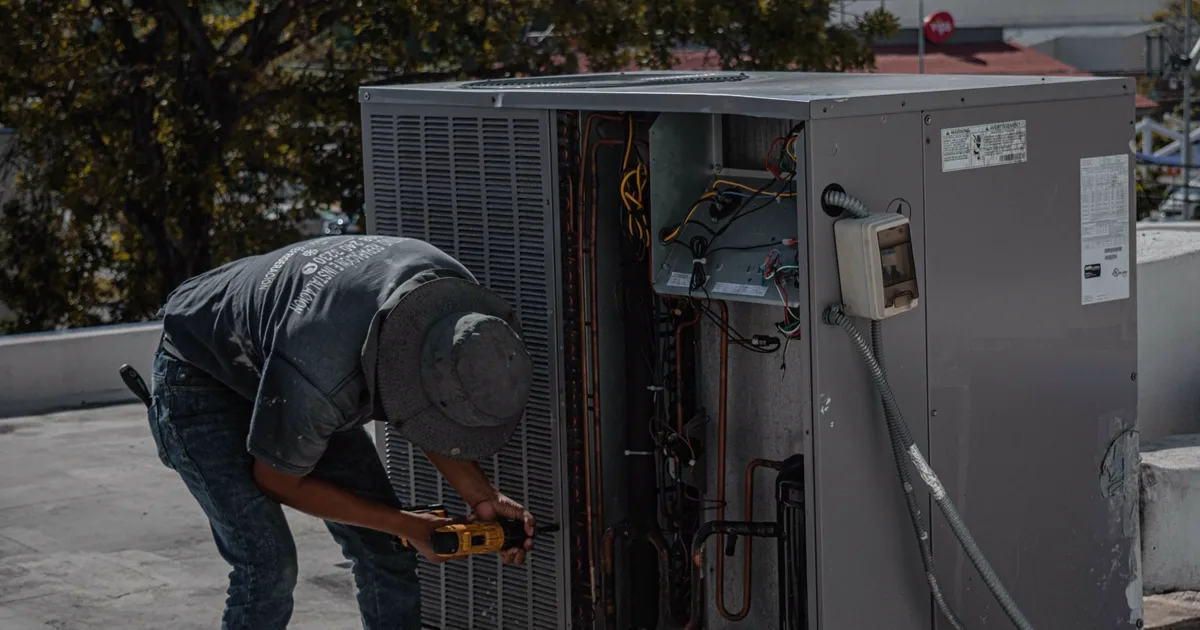
An HVAC technician at work on an outdoor unit. Photo by Richard Low Hong on Pexels.
Do you pay subcontractors or helpers, and how is that taxed?
Many HVAC contractors bring in a helper for installs or hire another tech for a big job. An employee gets a W-2. An independent contractor gets a Form 1099-NEC when the total paid in the year reaches the reporting threshold: $2,000 per payee for 2026, raised from $600 by the One Big Beautiful Bill Act (Public Law 119-21), for payments made on or after January 1, 2026. Income below $2,000 is still taxable to the person who earned it.
Misclassification is the risk to watch. The IRS looks at behavioral control, financial control, and the relationship between the parties, per IRS guidance on independent contractors. A helper who works set hours and uses your tools looks like an employee, while a licensed tech who sets their own schedule and works for several contractors looks like an independent contractor. Form SS-8 asks the IRS to decide the status. Payments to subcontractors go on Schedule C, line 11, contract labor. Get a Form W-9 from every subcontractor before the first payment.
When are quarterly estimated taxes due in 2026?
No employer withholds tax from an HVAC contractor’s checks, so the contractor pays during the year with Form 1040-ES. For tax year 2026, the due dates are April 15, 2026, June 15, 2026, September 15, 2026, and January 15, 2027, per the 2026 Form 1040-ES. None falls on a weekend or federal holiday, so none shifts. You generally must pay estimated tax if you expect to owe at least $1,000 in tax for 2026 after withholding and refundable credits, per IRS Publication 505 (2026). The safe harbor is the smaller of 90 percent of your 2026 tax or 100 percent of your 2025 tax, rising to 110 percent when prior-year adjusted gross income was over $150,000.
The IRS interest rate for individual underpayments in the fourth quarter of 2026 is 7 percent per year, per IRS News Release IR-2026-98. The failure-to-file penalty is 5 percent of unpaid tax per month, up to 25 percent, with a minimum of the lesser of $535 or 100 percent of the tax due for a 2026 return filed more than 60 days late, per IRS Revenue Procedure 2025-32, section 4.52. The $525 figure belongs to tax year 2025, not 2026.
Can an HVAC contractor claim the QBI deduction?
Yes, in many cases. The qualified business income deduction under Internal Revenue Code section 199A lets owners of pass-through businesses deduct up to 20 percent of qualified business income. For 2026, the full deduction is generally available when taxable income is at or below $201,750 for single filers or $403,500 for married filing jointly, per IRS Revenue Procedure 2025-32. Above those thresholds, wage and property limits phase in over $75,000 for single filers and $150,000 for joint filers. It is claimed on Form 8995 or Form 8995-A, and it lowers income tax only, not self-employment tax.
Frequently asked questions
What is the biggest tax deduction for an HVAC contractor?
The biggest deduction is usually the work truck, followed by tools and equipment. A contractor who drives 25,000 business miles in the second half of 2026 gets 25,000 times 76 cents, or $19,000, per IRS Announcement 2026-11. Labor paid to helpers and subcontractors is often larger still.
Does an HVAC contractor need a 1099 for every helper?
No. Form 1099-NEC is required when you pay an independent contractor $2,000 or more in total during 2026, per the One Big Beautiful Bill Act. An employee gets a Form W-2 instead. A helper paid less than $2,000 still reports the income, but no 1099-NEC is required.
What happens if an HVAC contractor misses a quarterly payment?
Interest starts from the due date of the missed payment, and the underpayment penalty is figured on Form 2210. The fourth-quarter payment due January 15, 2027 can be skipped without penalty if you file your 2026 return and pay the full balance by February 1, 2027, because January 31, 2027 falls on a Sunday, per the 2026 Form 1040-ES.
Conclusion
HVAC contractor taxes reward the contractor who tracks costs the same way they track jobs. Keep supplier invoices, tool receipts, and a mileage log with the date, destination, purpose, and miles for each trip. Tools under $2,500 can be expensed under the de minimis safe harbor. Larger equipment can use Section 179 up to $2,560,000 or 100 percent bonus depreciation in 2026. Mileage is 72.5 cents per mile through June 30 and 76 cents from July 1. Refrigerant, parts, license fees, insurance, and training are ordinary costs of the trade. Subcontractors paid $2,000 or more need a Form 1099-NEC, quarterly payments fall on April 15, June 15, September 15, and January 15, and the QBI deduction can take up to 20 percent off qualified business income. Sales tax is a state tax, so check your state revenue agency before you set prices.
Run your 2026 numbers with our free tax tools, no signup needed.
This article is for education, not tax advice. Tax rules change, and state rules differ from federal rules. Check the IRS sources listed below or talk with a tax professional before you rely on any figure for your own return.
References
- IRS, Revenue Procedure 2025-32, Annual Inflation Adjustments for 2026. https://www.irs.gov/pub/irs-drop/rp-25-32.pdf
- IRS, News Release IR-2025-128, IRS Sets 2026 Business Standard Mileage Rate at 72.5 Cents Per Mile (Notice 2026-10). https://www.irs.gov/newsroom/irs-sets-2026-business-standard-mileage-rate-at-725-cents-per-mile-up-25-cents
- IRS, Announcement 2026-11, Revised 2026 Standard Mileage Rates, Internal Revenue Bulletin 2026-29. https://www.irs.gov/irb/2026-29_irb
- IRS, Publication 946, How to Depreciate Property. https://www.irs.gov/publications/p946
- IRS, Publication 463, Travel, Gift, and Car Expenses. https://www.irs.gov/publications/p463
- IRS, Publication 535, Business Expenses. https://www.irs.gov/publications/p535
- IRS, Publication 505, Tax Withholding and Estimated Tax. https://www.irs.gov/publications/p505
- IRS, Topic No. 554, Self-Employment Tax. https://www.irs.gov/taxtopics/tc554
- IRS, Form 1040-ES, Estimated Tax for Individuals (2026). https://www.irs.gov/forms-pubs/about-form-1040-es
- IRS, Schedule C (Form 1040), Profit or Loss From Business. https://www.irs.gov/forms-pubs/about-schedule-c-form-1040
- IRS, Schedule SE (Form 1040), Self-Employment Tax. https://www.irs.gov/forms-pubs/about-schedule-se-form-1040
- IRS, News Release IR-2026-98, Interest Rates for Fourth Quarter 2026. https://www.irs.gov/newsroom/interest-rates-remain-the-same-for-the-fourth-quarter-of-2026
- IRS, Notice 2015-82, Increase in De Minimis Safe Harbor Limit. https://www.irs.gov/pub/irs-drop/n-15-82.pdf
- IRS, Independent Contractor (Self-Employed) or Employee. https://www.irs.gov/businesses/small-businesses-self-employed/independent-contractor-self-employed-or-employee
- IRS, Qualified Business Income Deduction. https://www.irs.gov/newsroom/qualified-business-income-deduction
- Social Security Administration, Contribution and Benefit Base. https://www.ssa.gov/oact/cola/cbb.html
- U.S. Environmental Protection Agency, Section 608 Technician Certification. https://www.epa.gov/section608