
Interior designer taxes are the US federal tax rules for earning money by designing rooms and homes for clients as an independent worker. The IRS treats most interior designers as self-employed. You report design fees and furniture markup on Schedule C, pay income tax plus self-employment tax on your profit, and make quarterly payments when you owe $1,000 or more. See our complete tax guide for freelancers and consultants and our graphic designer tax deductions guide.
Do interior designers have to pay taxes?
Yes. Every dollar you earn from design work is taxable income. Design fees and the markup you add to furniture and goods all count as business income, and no 1099 form is needed to create the tax. You must file and pay self-employment tax once net earnings reach $400 for the year, under 26 U.S.C. section 1402(b); net earnings means revenue minus deductible expenses.
How much is self-employment tax for a designer?
Self-employment tax is 15.3 percent of your net earnings from self-employment, and it applies once those net earnings reach $400 for the year. The rate has two parts: 12.4 percent for Social Security and 2.9 percent for Medicare, under IRS Schedule SE for tax year 2026.
Schedule SE multiplies net profit by 92.35 percent, then applies the 15.3 percent rate. The Social Security portion applies only to the first $184,500 of combined wages and net earnings for 2026, the wage base published by the Social Security Administration; the Medicare portion has no cap. You can deduct one-half of your self-employment tax on Schedule 1 of Form 1040, line 15; on $60,000 of net profit, that is about $4,239.
Which 1099 form will a designer receive?
The form depends on who pays you: a company reports on Form 1099-NEC, a payment processor on Form 1099-K, and homeowners who pay you directly usually send no form at all.
| Payer | Form | 2026 federal threshold |
| Company client (direct pay) | 1099-NEC, box 1a | $2,000 or more |
| Stripe, Square, other processors | 1099-K | Over $20,000 and over 200 transactions |
| Homeowners paying directly | Usually none | You report the income yourself |
The 1099-NEC threshold rose from $600 to $2,000 for payments made after December 31, 2025, under the One Big Beautiful Bill Act. The same law restored the 1099-K rule of more than $20,000 in gross payments and more than 200 transactions.
Payments for merchandise are excepted from 1099-NEC reporting, under the Instructions for Forms 1099-MISC and 1099-NEC (December 2026), so a business client that pays for design services plus furniture may report only the service portion. Either way, report all income from your own invoices and payment records.
What can interior designers deduct?
You can deduct any ordinary and necessary cost of running your design business, under Internal Revenue Code section 162. Each deduction lowers the profit the IRS taxes.
| Deduction | Schedule C line | Notes for 2026 |
| Furniture and goods bought for clients | Line 4 (Part III) | Cost of goods sold, line 42 |
| Home studio (simplified method) | Line 30 | $5 per sq ft, max $1,500 |
| Rented studio space | Line 20b | Rent for other business property |
| Samples and fabric libraries | Line 22 | Supplies, as consumed |
| Design software subscriptions | Line 18 | Office expenses |
| Mileage | Line 9 | 72.5 cents/mile Jan-Jun; 76 cents Jul-Dec |
| ASID / IIDA dues and continuing education | Line 27b | Itemized in Part V |
| Computer, camera, and equipment | Line 13 | Section 179 or depreciation, Form 4562 |
| Subcontractors (installers, workrooms) | Line 11 | Contract labor; 1099-NEC at $2,000 |
A room used regularly and exclusively for design work qualifies as a home office, under Internal Revenue Code section 280A. The simplified method gives $5 per square foot on up to 300 square feet, a maximum of $1,500, under Revenue Procedure 2013-13. Rent for a separate studio goes on line 20b, with no exclusive-use test and no cap.
Designers get one break most freelancers do not: space used regularly to store inventory or product samples need not meet the exclusive-use test, under section 280A(c)(2), if your home is the sole fixed location of your business and the business sells products at retail or wholesale.
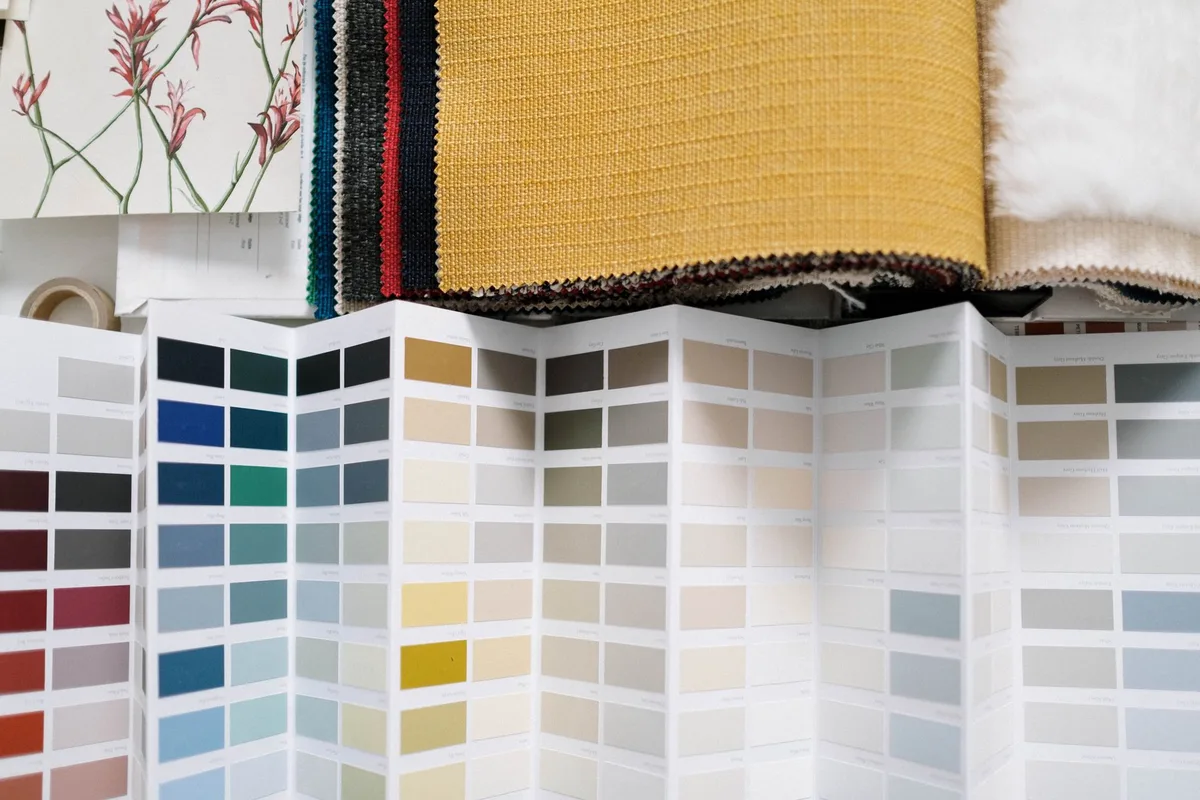
Samples follow a simple rule: you can only deduct what you paid for. Fabric swatches, tile chips, and paint decks you bought are supplies on line 22, deductible as you consume them. Samples a vendor sent free have no cost, so there is nothing to deduct.
Furniture and goods bought for a client are cost of goods sold, figured in Part III of Schedule C and entered on line 4. Say you buy a sofa for $2,000 and bill the client $2,400: the $2,400 is gross receipts on line 1, the $2,000 is cost of goods sold, and only the $400 markup plus your design fee is profit. Most designers can skip formal inventory accounting under the small business exception in section 471(c), for businesses averaging $32 million or less in gross receipts over the prior three years for 2026, under Revenue Procedure 2025-32.
Design software subscriptions are office expenses on line 18: SketchUp, AutoCAD, Chief Architect, Houzz Pro, and Mydoma Studio. A laptop, a monitor, and a camera for portfolio photos are equipment, and section 179 lets you expense the full cost in the year you place each item in service. The 2026 limit is $2,560,000, under Revenue Procedure 2025-32, and the election is claimed on Form 4562. Items costing $2,500 or less each can use the de minimis safe harbor instead, capped at $2,500 per item without an applicable financial statement.
The standard mileage rate for 2026 is 72.5 cents per mile for January through June and 76 cents per mile for July through December, under IRS Notice 2026-10 and Announcement 2026-11. A designer who drives 12,000 business miles split evenly across the year deducts $8,910. With a home office that qualifies as your principal place of business, drives from home to client sites are business miles; without one, the drive to your first client of the day is a personal commute, under IRS Publication 463 (2025). Overnight travel to a trade show or distant install follows the same publication: lodging and transport are deductible, business meals 50 percent.
Professional liability insurance goes on Schedule C, line 15, under the Instructions for Schedule C (Form 1040). Your own health insurance goes on Schedule 1 of Form 1040, line 17, when eligible, not on Schedule C. ASID and IIDA dues and continuing education that maintains or improves your skills are deductible, under Treasury Regulation section 1.162-5. Education that qualifies you for a substantially different trade is not.
[Image: Fabric swatches and a color palette spread on a table for an interior design project — file: interior-designer-taxes-body.webp]
Photo by cottonbro studio on Pexels. Source: https://www.pexels.com/photo/fabric-samples-and-color-palette-selection-on-flat-surface-6583362/
See what you’d owe: Estimate your 2026 designer taxes with our free tax tools.
Do designers owe sales tax on furniture they resell?
Sales tax is a state tax, not a federal one, and the rules change from state to state. The usual pattern is that goods bought for resale are exempt at purchase with a resale certificate, and the tax is charged instead on the sale to the final customer. Whether your state follows that pattern, and whether design services are taxable, depends on your state’s law, so check with your state revenue department before you buy or bill.
When the state imposes the sales tax on you as the seller, you deduct it on Schedule C, line 23, and include any amount collected from the buyer in gross receipts on line 1. When the state imposes it on the buyer and you only collect and remit it, the tax is neither income nor a deduction, under the Instructions for Schedule C (Form 1040). The same split decides whether sales tax belongs on a 1099-NEC: tax imposed on you is part of the reportable payment, while tax imposed on the buyer is not, under the Instructions for Forms 1099-MISC and 1099-NEC (December 2026).
Can designers claim the QBI deduction?
Yes. The qualified business income deduction under Internal Revenue Code section 199A lets most sole proprietors deduct up to 20 percent of their qualified business income. Interior design is not one of the 13 specified service fields in Treasury Regulation section 1.199A-5, so the SSTB phase-out does not apply to a typical design practice. The regulation’s consulting field covers advice and counsel, but it excludes consulting embedded in the sale of goods with no separate payment for it, which covers a designer who bundles design with furniture procurement. A practice selling design advice alone should confirm its status with a tax professional.
The full 20 percent applies when your taxable income before the deduction is at or below $201,750 single or $403,500 joint in 2026, under Revenue Procedure 2025-32. Above those figures, the W-2 wage and property limits apply instead. The deduction reduces taxable income, not adjusted gross income, and you claim it on Form 1040, line 13; it does not reduce self-employment tax.
Take a single designer with $60,000 of net profit and no other income. Self-employment tax is $8,478; one-half of it, $4,239, comes off as an adjustment, leaving adjusted gross income of $55,761. Less the 2026 single standard deduction, $16,100, taxable income before the QBI deduction is $39,661. The QBI deduction is the lesser of 20 percent of qualified business income ($11,152) or 20 percent of taxable income before the deduction ($7,932), so it is $7,932. Taxable income is then $31,729, and federal income tax at the 2026 single rates is about $3,559. Total federal tax is $12,037, about $3,009 per quarter.
When do designers pay quarterly estimated taxes?
No client withholds income tax from your payments. If you expect to owe $1,000 or more in federal tax for 2026 after withholding and credits, make estimated payments using Form 1040-ES. The 2026 due dates are April 15, June 15, and September 15, 2026, and January 15, 2027.
The safe harbor rule avoids the underpayment penalty if you pay at least 90 percent of this year’s tax or 100 percent of last year’s, split across the four due dates, rising to 110 percent if last year’s adjusted gross income was over $150,000.
Frequently asked questions
Do I have to send a 1099-NEC to the installer I hired?
If the installer is an individual or partnership, the work was for your business, and 2026 payments reached $2,000, yes. File Form 1099-NEC by February 1, 2027, and collect a Form W-9 before the first payment.
Should I form an LLC for my design business?
An LLC changes your legal liability, not your federal income tax. A single-member domestic LLC is not treated as a separate entity for federal income tax purposes, so you still file Schedule C and pay the same self-employment tax, under the Instructions for Schedule C (Form 1040).
Conclusion
Four habits cover interior designer taxes: report all design fees and furniture markup on Schedule C, with goods for clients in Part III as cost of goods sold; pay self-employment tax of 15.3 percent on 92.35 percent of net profit once net earnings reach $400; deduct your studio, samples, software, and mileage; and make quarterly estimated payments when you expect to owe $1,000 or more.
Run your 2026 numbers: Estimate your designer taxes with our free 1099 tax tools.
This article is for education only and is not tax advice. Tax rules change, and your situation may differ. Check IRS.gov or talk to a qualified tax professional before you file.
References
- Internal Revenue Service, Schedule C (Form 1040), Profit or Loss From Business, instructions (2025 edition; 2026 edition not yet posted). https://www.irs.gov/instructions/i1040sc
- Internal Revenue Service, Schedule SE (Form 1040), Self-Employment Tax, instructions for tax year 2026. https://www.irs.gov/instructions/i1040se
- Internal Revenue Service, Self-employment tax (Social Security and Medicare taxes). https://www.irs.gov/businesses/small-businesses-self-employed/self-employment-tax-social-security-and-medicare-taxes
- Internal Revenue Service, Instructions for Forms 1099-MISC and 1099-NEC, December 2026. https://www.irs.gov/instructions/i1099mec
- Internal Revenue Service, Fact Sheet FS-2025-08, IRS revises and updates Form 1099-K frequently asked questions, October 2025. https://www.eitc.irs.gov/pub/taxpros/fs-2025-08.pdf
- Internal Revenue Service, Notice 2026-10 and Announcement 2026-11, Standard mileage rates for 2026. https://www.irs.gov/tax-professionals/standard-mileage-rates
- Internal Revenue Service, Publication 463, Travel, Gift, and Car Expenses, 2025. https://www.irs.gov/publications/p463
- Internal Revenue Service, Publication 505, Tax Withholding and Estimated Tax, 2026. https://www.irs.gov/publications/p505
- Internal Revenue Service, Publication 583, Starting a Business and Keeping Records. https://www.irs.gov/publications/p583
- Internal Revenue Service, Publication 587, Business Use of Your Home. https://www.irs.gov/publications/p587
- Internal Revenue Service, Publication 946, How to Depreciate Property. https://www.irs.gov/publications/p946
- Internal Revenue Service, Revenue Procedure 2025-32, Annual inflation adjustments for tax year 2026. https://www.irs.gov/pub/irs-drop/rp-25-32.pdf
- Internal Revenue Service, Revenue Procedure 2013-13, Simplified method for home office deduction. https://www.irs.gov/pub/irs-drop/rp-13-13.pdf
- Internal Revenue Service, Form 1040-ES, Estimated Tax for Individuals, instructions for 2026. https://www.irs.gov/forms-pubs/about-form-1040-es
- Internal Revenue Service, Estimated taxes. https://www.irs.gov/businesses/small-businesses-self-employed/estimated-taxes
- Internal Revenue Service, Qualified business income deduction. https://www.irs.gov/newsroom/qualified-business-income-deduction
- Internal Revenue Service, Tax Cuts and Jobs Act, Provision 11011 Section 199A, Qualified Business Income Deduction FAQs. https://www.irs.gov/newsroom/tax-cuts-and-jobs-act-provision-11011-section-199a-qualified-business-income-deduction-faqs
- Treasury Regulation section 1.199A-5, Specified service trades or businesses. https://codes.findlaw.com/cfr/title-26-internal-revenue/cfr-sect-26-1-199a-5/
- 26 U.S.C. section 280A, Disallowance of certain expenses in connection with business use of home. https://uscode.house.gov/us/usc/119-136/t26/s280A/
- Social Security Administration, Contribution and benefit base for 2026 ($184,500). https://www.ssa.gov/oact/cola/cbb.html