By Casey Renee Tom | Reviewed November 2026 for tax year 2026
Electrician tax deductions for a self-employed electrician are the ordinary and necessary costs of running an electrical business, reported on Schedule C (Form 1040). Tools, job materials, vehicle costs, license fees, liability insurance, and training all count when they relate to the business. Each deduction lowers net profit, the base for income and self-employment tax. The 2026 figures that matter most are the split mileage rate and the 15.3 percent self-employment tax rate.
What can a self-employed electrician deduct?
A self-employed electrician can deduct any cost that is ordinary and necessary for the electrical business, per IRS Publication 334 (2025). Ordinary means other electricians commonly pay it. Necessary means it helps the business earn income. The cost must relate to business work, and you need records to support it.
| Deduction | What it covers | Schedule C line |
|---|---|---|
| Tools and small equipment | Hand tools, meters, drills, consumables | 22 or 27b |
| Job materials | Wire, conduit, breakers, panels, fixtures | Cost of goods sold or 22 |
| Vehicle | Mileage or actual van and truck costs | 9 |
| License and permits | State license, renewal, permit fees | 23 |
| Insurance | General liability, workers compensation | 15 |
| Contract labor | Pay to helpers who are not employees | 11 |
Which tools and equipment can electricians deduct?
Hand tools and test gear used for electrical work are deductible when they are ordinary and necessary for the trade: wire strippers, pliers, screwdrivers, fish tape, drills, and multimeters, plus consumables such as wire nuts, tape, and screws. Items used up within the year are generally deducted as supplies on Schedule C, line 22.
How do the de minimis safe harbor and Section 179 work for tools?
Larger tools follow one of three paths. The de minimis safe harbor election lets a business without audited financial statements expense items that cost $2,500 or less each in the year of purchase, under Treasury Regulation section 1.263(a)-1(f). Section 179 lets you expense qualifying equipment in the year you place it in service, up to $2,560,000 for tax year 2026, with the limit phasing out once total qualifying purchases exceed $4,090,000, per Revenue Procedure 2025-32, section 4.24. Claim it on Form 4562. Bonus depreciation of 100 percent also applies to qualifying property acquired and placed in service after January 19, 2025, per Internal Revenue Code section 168(k).
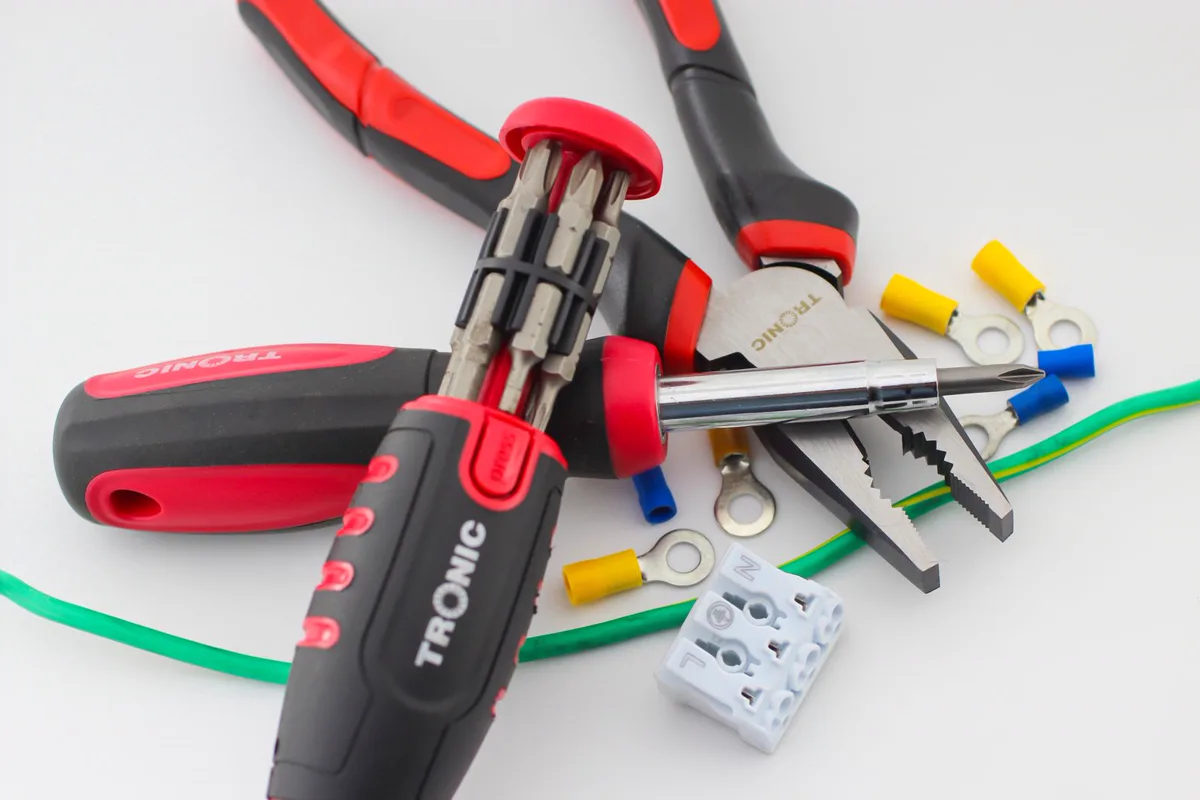
Photo by ERIC MUFASA on Pexels. Electrical hand tools and cable lugs.
How do electricians deduct materials and supplies?
Wire, conduit, breakers, panels, and fixtures bought for a job are a business cost, deducted as cost of goods sold or as supplies on Schedule C. Materials installed in a customer job during the year are deducted for that year, while materials still on the shelf at December 31 are not yet deducted. Keep supplier invoices filed by job.
What vehicle deductions can electricians claim?
A work van or truck is usually an electrician’s largest deduction after labor. You choose one method per vehicle per year: the standard mileage rate or actual expenses, per IRS Publication 463 (2025), chapter 4. You cannot claim both for the same vehicle in the same year.
The 2026 standard mileage rate is split because the IRS raised it mid-year. It is 72.5 cents per business mile driven January 1 through June 30, 2026, per IRS Notice 2026-10, and 76 cents per business mile driven July 1 through December 31, 2026, per IRS Announcement 2026-11. An electrician with 6,000 business miles in each half claims $8,910.
Actual expenses mean gas, repairs, tires, insurance, registration, and depreciation or lease payments, split between business and personal use. If you use the standard mileage rate in the first year a vehicle is placed in service for business, you can switch to actual expenses later. If you use actual expenses first, you cannot switch later.
What are the Section 179 limits for a work van or truck?
For 2026, the Section 179 deduction for a heavy SUV weighing 6,001 to 14,000 pounds is capped at $32,000, per IRS Publication 946. A pickup with a bed at least 6 feet long, a cargo van, and a 9-plus-passenger vehicle are not subject to that cap. The first-year depreciation cap is $20,300 for 2026, per Revenue Procedure 2026-15. If you lease, the lease inclusion amount applies when the fair market value exceeds $62,000.
Are license, insurance, and training deductible?
Yes, when they relate to the electrical business. State electrical license fees, renewal fees, and permit fees are deductible on Schedule C (Form 1040), line 23. General liability insurance and workers compensation premiums for employees go on Schedule C, line 15.
Training is deductible when it maintains or improves the skills you need for your current electrical work: National Electrical Code update courses and OSHA safety training. Courses that qualify you for a new trade are not deductible, per IRS Publication 970 (2025), chapter 12. Safety gear is deductible: arc-flash clothing, safety glasses, gloves, and hard hats. Everyday clothing is not deductible, even if you wear it only to job sites, per IRS Topic No. 513.
What about home office, phone, and software?
Many electricians run the business from home. The home office deduction requires a space used exclusively and regularly for business, per IRS Publication 587 (2025). A desk in a room you also live in does not qualify. The simplified method pays $5 per square foot of office space, up to 300 square feet, for a maximum of $1,500, per IRS Publication 587 (2025). The regular method uses Form 8829 and deducts the business share of home costs. Phone, internet, and business software are deductible for the business share.
How do deductions change what an electrician owes?
Deductions lower net profit on Schedule C, and net profit drives both income tax and self-employment tax. Self-employment tax is 15.3 percent of net earnings: 12.4 percent for Social Security and 2.9 percent for Medicare, per the IRS page on self-employment tax. The Social Security part applies only up to the 2026 wage base of $184,500, per Schedule SE for 2026. You owe the tax when net earnings reach $400 or more for the year, per 26 U.S.C. section 1402(b).
Net earnings are not net profit. Schedule SE multiplies net profit by 92.35 percent first. Take an electrician with $60,000 of net profit: net earnings are 92.35 percent of $60,000, or $55,410, and self-employment tax is 15.3 percent of $55,410, or $8,478. You can deduct one-half of that tax on Schedule 1 (Form 1040), line 15.
The qualified business income deduction can cut income tax further. Under Internal Revenue Code section 199A, a pass-through business can deduct up to 20 percent of qualified business income. For 2026, the full deduction is available when taxable income is below $201,750 for single filers and below $403,500 for married couples filing jointly, per Revenue Procedure 2025-32, section 4.26. The same $60,000 profit would support a QBI deduction of up to $12,000. The QBI deduction lowers income tax only; it does not lower self-employment tax.
See what you would owe with our free 1099 tax calculator, with no signup needed. See your 2026 electrician tax estimate with our free tax tools
How do electricians pay estimated tax?
No employer withholds tax for a self-employed electrician, so you pay in four quarterly installments with Form 1040-ES. The 2026 due dates are April 15, June 15, and September 15, 2026, and January 15, 2027, per the Instructions for Form 1040-ES (2026). Estimated tax is generally due when you expect to owe $1,000 or more for the year.
The safe harbor avoids an underpayment penalty: pay at least 90 percent of the current year tax or 100 percent of the prior year tax. The prior year figure is 110 percent when adjusted gross income exceeds $150,000. Underpayment interest for the fourth quarter of 2026 is 7 percent per year, per IRS news release IR-2026-98. For a 2026 return filed more than 60 days late, the failure-to-file minimum is $535, per Revenue Procedure 2025-32, section 4.52.
Do electricians need to file 1099s for helpers?
It depends on whether the helper is an employee or an independent contractor. The IRS looks at behavioral control, financial control, and the relationship between the parties, per the IRS page on independent contractors. An electrician who sets the helper’s hours, supplies the tools, and directs the work usually has an employee. A subcontractor who brings their own tools and sets their own hours is usually an independent contractor. When the facts are unclear, either side can ask the IRS to decide by filing Form SS-8.
Pay a subcontractor $2,000 or more during calendar year 2026 and you must file Form 1099-NEC, reporting the amount in box 1a. The $2,000 threshold applies to payments made on or after January 1, 2026, under the One Big Beautiful Bill Act (Public Law 119-21), which raised it from $600. The form is due February 1, 2027. The $2,000 figure controls whether you must file the form, not whether the helper must report the income. Form 1099-K applies only above $20,000 and 200 transactions.
What records should electricians keep?
Keep income records, a mileage log with odometer readings, receipts for every business cost, and bank statements for at least three years after you file. Separate business and personal spending with a dedicated business account.
Frequently asked questions about electrician tax deductions
Can a self-employed electrician deduct tools?
Yes. Hand tools, meters, and consumables used for electrical work are deductible as supplies or under the de minimis safe harbor when each item costs $2,500 or less. Larger equipment is deducted through Section 179 or bonus depreciation.
Can electricians deduct a work truck?
Yes, by the standard mileage rate or by actual expenses, but not both for the same vehicle in the same year. The 2026 mileage rate is 72.5 cents per mile through June 30 and 76 cents per mile from July 1. A heavy SUV is subject to a $32,000 Section 179 cap.
Are license and insurance costs deductible for electricians?
Yes. State license and permit fees, general liability insurance, and workers compensation premiums for employees are ordinary and necessary business expenses for an electrical business.
Can an electrician deduct training and code books?
Yes, when the training maintains or improves skills for current electrical work, such as National Electrical Code update courses and license renewal classes. Code books are deductible the same way.
What can a self-employed electrician not deduct?
Personal expenses, everyday clothing, commuting from home to a regular job site, and fines or penalties are not deductible. Meals are deductible at 50 percent, not in full.
Conclusion
Report all job income on Schedule C, even when no 1099 arrives. Deduct tools under the $2,500 de minimis rule or Section 179. Pay self-employment tax of 15.3 percent on net earnings of $400 or more, and pay estimated tax when you expect to owe $1,000 or more.
Run your 2026 numbers with our free tax tools, with no signup needed. Run your 2026 electrician numbers with our free tax tools
For the full picture across the trades, see The Complete Tax Guide for Tradespeople and Contractors.
This article is for education, not tax advice. Tax rules depend on your facts, and figures change by tax year. Check the IRS sources listed below or talk with a tax professional before you file.
References
- IRS. Publication 334 (2025), Tax Guide for Small Business. https://www.irs.gov/publications/p334
- IRS. Publication 463 (2025), Travel, Gift, and Car Expenses. https://www.irs.gov/publications/p463
- IRS. Publication 946, How to Depreciate Property. https://www.irs.gov/publications/p946
- IRS. Publication 587 (2025), Business Use of Your Home. https://www.irs.gov/publications/p587
- IRS. Publication 970 (2025), Tax Benefits for Education. https://www.irs.gov/publications/p970
- IRS. Standard mileage rates. https://www.irs.gov/tax-professionals/standard-mileage-rates
- IRS. Notice 2026-10, 2026 standard mileage rates. https://www.irs.gov/forms-pubs/the-standard-mileage-rates-and-maximum-automobile-fair-market-values-have-been-updated-for-2026
- IRS. Announcement 2026-11, Internal Revenue Bulletin 2026-29. https://www.irs.gov/irb/2026-29_irb
- IRS. Self-employment tax (Social Security and Medicare taxes). https://www.irs.gov/businesses/small-businesses-self-employed/self-employment-tax-social-security-and-medicare-taxes
- IRS. Schedule SE (Form 1040) 2026. https://www.irs.gov/pub/irs-pdf/f1040sse.pdf
- IRS. Instructions for Form 1040-ES (2026), Estimated Tax for Individuals. https://www.irs.gov/forms-pubs/about-form-1040-es
- IRS. Instructions for Forms 1099-MISC and 1099-NEC (2026). https://www.irs.gov/instructions/i1099gi
- IRS. Revenue Procedure 2025-32, annual inflation adjustments for 2026. https://www.irs.gov/pub/irs-drop/rp-25-32.pdf
- IRS. Revenue Procedure 2026-15, depreciation limitations for passenger automobiles. https://www.irs.gov/pub/irs-drop/rp-26-15.pdf
- IRS. IR-2026-98, interest rates for the fourth quarter of 2026. https://www.irs.gov/newsroom/interest-rates-remain-the-same-for-the-fourth-quarter-of-2026
- IRS. Independent contractor (self-employed) or employee. https://www.irs.gov/businesses/small-businesses-self-employed/independent-contractor-self-employed-or-employee
- IRS. Topic No. 513, Work Clothes and Uniforms. https://www.irs.gov/taxtopics/tc513
- IRS. Schedule C (Form 1040), Profit or Loss From Business. https://www.irs.gov/forms-pubs/about-schedule-c-form-1040